
In this blog, the Association’s Executive Director, Andy Murray, explores how today’s King’s Speech positions major projects at the centre of economic growth, energy security and public service transformation, and what the emerging legislative agenda could mean for Association members and the future delivery of infrastructure across the UK.
The 2026 King’s Speech put infrastructure and service transformation at the heart of the legislative agenda for the next term of parliament, with His Majesty’s opening remarks including “the United Kingdom’s economic security depends upon world class infrastructure” and “the [government] will use public investment to shape markets and attract further private investment.”
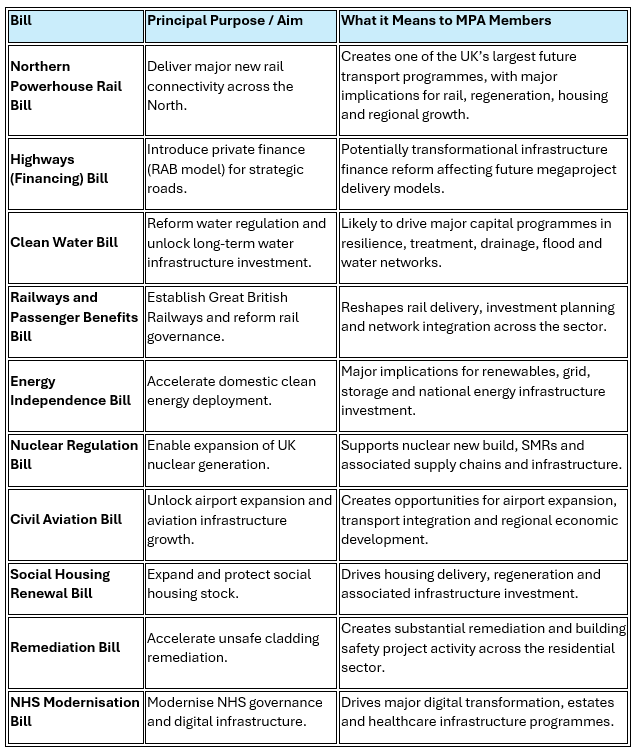
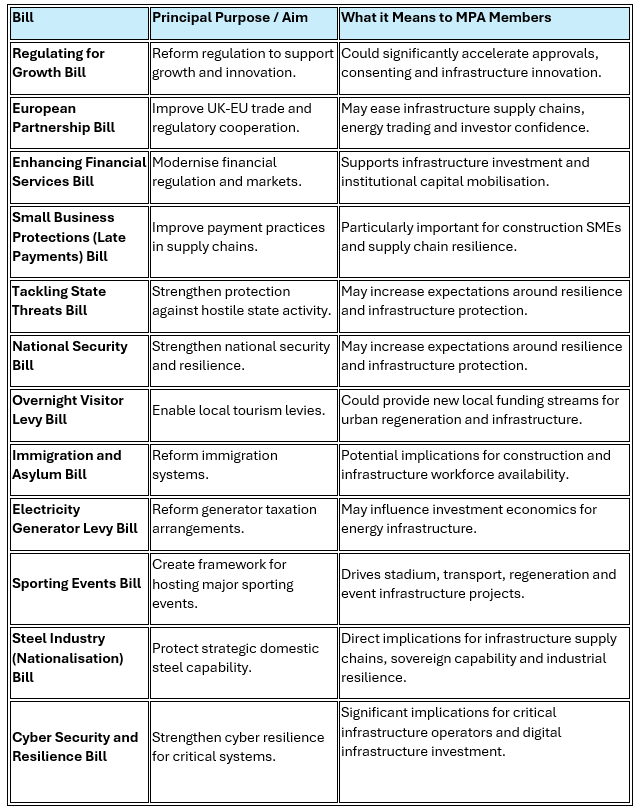
It is perhaps one of the most infrastructure-focused legislative programmes in recent years, with 10 of the 39 proposed Bills directly triggering major projects and a further 12 enabling or influencing them. It includes major commitments on rail, energy, water, housing, digital systems and public service reform, alongside wider changes to regulation, governance and infrastructure finance.
What is striking, however, is not simply the scale of the programme, but how infrastructure is being framed. The Speech increasingly treats major projects not as isolated investments, but as instruments of:
- economic growth,
- energy security,
- industrial resilience,
- regional regeneration,
- and public service transformation.
Transport is linked to productivity and labour market integration. Energy policy is tied to industrial strategy and national resilience. Housing is connected to retrofit and regeneration. NHS reform focuses heavily on digital integration and organisational modernisation. And there is a thread running through them regarding Sovereign Capability which was highlighted in the very first sentence from His Majesty, “An increasingly dangerous and volatile world threatens the United Kingdom, with the conflict in the Middle East only the most recent example. Every element of the nation’s energy, defence and economic security will be tested.”
In many respects the treatment of infrastructure as a means to an end reflects a more systems-oriented understanding of infrastructure, which was a key theme from our 2025 Annual Conference on the “connectedness” of our major projects. The Speech also signals an important shift away from a purely “build more” narrative. Alongside major new schemes such as Northern Powerhouse Rail and airport expansion is a strong emphasis on remediation, resilience, maintenance and renewal of existing systems.
The Clean Water Bill focuses heavily on leakage reduction and ageing infrastructure. The Remediation Bill addresses unsafe cladding in existing buildings. Roads funding includes significant investment in renewing deteriorating assets. NHS reform largely centres on fixing fragmented legacy systems.
This feels like a recognition that the UK’s infrastructure challenge is increasingly about adapting and maintaining existing systems as much as delivering entirely new assets.
Yet while the policy narrative is becoming more interconnected, the Speech raises important questions about whether the delivery systems are evolving at the same pace. Many of the ambitions outlined depend on coordination across multiple institutions, regulators and sectors:
- retrofit requires housing, energy and local government systems to align;
- water resilience depends on regulators, utilities and environmental bodies coordinating effectively;
- regional growth relies on transport, housing and skills policy operating together.
However, most of the proposed reforms remain organised through traditional departmental structures. As we explored in our 2025 Annual Conference, this may become one of the defining tensions of the next phase of major projects delivery: the ambitions are increasingly interconnected, but governance, funding and accountability remain siloed. The King’s Speech suggests that this challenge is now moving from conference discussion into practical reality.
Not unexpectedly, the Speech and the accompanying 129 pages of briefing notes, say relatively little about delivery capacity. We assume we will see more on that from the National Infrastructure and Service Transformation Authority in the coming months and hopefully we will hear more from NISTA’s CEO Becky Wood at our Prestige Lecture on 30th June.
The direction of travel is increasingly clear: infrastructure is being positioned less as a collection of standalone projects and more as part of wider economic and societal systems. The question now is whether the institutions, governance models and delivery capability can evolve quickly enough to support that shift.
A deeper dive into the legislative programme
From an initial scan of the 39 bills, we identified three groups. Those bills directly triggering or requiring major projects, those bills that enable or may have an impact on major projects and others that have little or no impact.
Group 1 – Direct impact
Group 2 – Enabling / may impact
Some headline numbers to leave you with!
- 39 Bills and Draft Bills announced in total.
- 4 major themes: Economic Security, Public Service Reform, Energy Security, National Security
- £830bn expected from EU-UK trade
- £104bn water sector private investment unlocked
- £45bn for Northern Powerhouse Rail
- £27bn on Road investment programme and a further £7.3bn on Local roads and potholes
- £11.8bn AI contribution to UK economy
- 4,310 unsafe buildings identified with unsafe cladding, of which only 35% remediated so far
- 50 years since the last reform of policing of this scale (a once in a generation transformation programme?)
Read the King’s Speech here.