
Today, Chancellor John Healey presented the 2026 Budget to Parliament. Our Executive Director, Andy Murray, followed the speech and has picked out the key announcements and points of interest for our members. Here are his highlights.
My first impression was of a Budget built around marginal gains. Like the approach associated with elite cycling, there were many individual adjustments intended to add up to a meaningful improvement. The test will be whether they reinforce each other, and whether the organisations implementing them have the capacity to deliver.
The sequence of the speech was revealing too. After the OBR update, energy was the first substantive topic; housing provided the closing emphasis. You would expect a Chancellor to give particular prominence to the opening and closing of his argument. On energy, he combined immediate help with bills with longer-term changes to strengthen energy security, reduce exposure to wholesale gas prices, and accelerate grid connections. Although he did not explicitly repeat the commitment to 1.5 million homes, choosing housing as his final topic perhaps signals that delivery remains an important priority for this government.
The housing measures deserve members’ attention. The government has committed to no major changes to building regulations for the remainder of this Parliament, while retaining exceptions for building safety, including the Grenfell Inquiry recommendations, and allowing proportionate amendments. That offers greater regulatory predictability, although it is not a blanket freeze on planning or building requirements.
The proposed biodiversity net gain exemption is similarly specific: residential brownfield developments on sites up to 1.5 hectares in England, with implementation timing still to follow. Meanwhile, the Budget papers state that biodiversity net gain becomes mandatory for Nationally Significant Infrastructure Projects from November 2026. Members should therefore distinguish the targeted easing for smaller brownfield housing sites from the requirements facing major infrastructure.
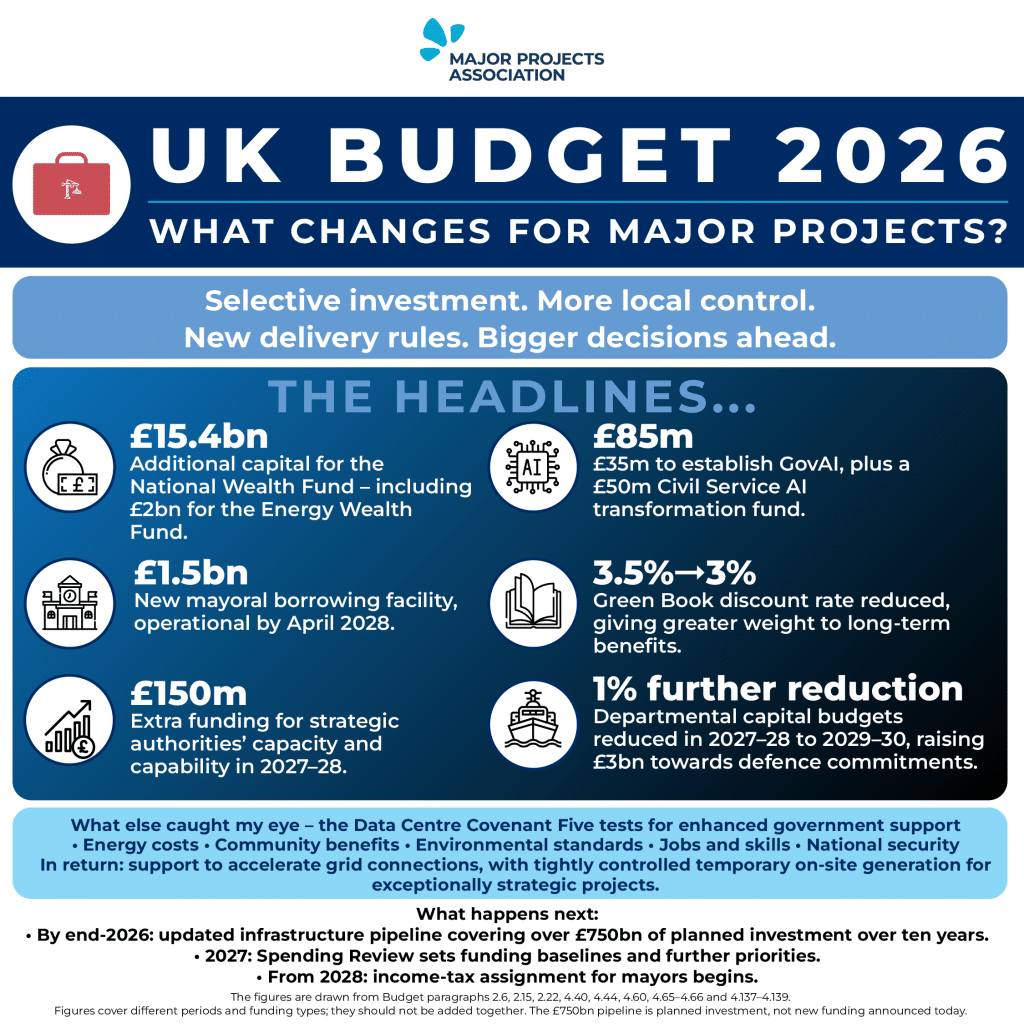
There were relatively few new multibillion-pound announcements. The £15.4bn additional capital for the National Wealth Fund stood out, although investment capacity still needs to translate into financed, approved and deliverable projects.
Procurement reform was mentioned by the Chancellor, but with little detail in his speech. The supporting papers promise stronger support for UK supply chains, innovation and skills, alongside faster defence contracting. They also propose legislation to reduce the risk of legal challenges leaving critical infrastructure projects in limbo. There is a direct skills implication for major projects too. The Budget says apprentices must account for at least 3% of the workforce on large government construction and infrastructure projects, alongside £100m to expand mayoral apprenticeship services. The practical details will matter, but this strengthens the connection between the project pipeline and developing the people needed to deliver it.
Devolution continues through further changes to funding and powers, particularly the assignment and retention of tax revenues. These could give local leaders greater certainty to invest. But the practical impact will depend on the responsibilities transferred, the funding baselines and the capability available locally. We will be exploring this further in our seminar on government project delivery and devolution in March 2027.
Supporting devolution (and place), the detail in the Budget papers on Green Book reform is another welcome development. The Budget formalises the discount-rate reduction from 3.5% to 3% and introduces guidance on place-based and proportionate business cases. The place-based approach connects closely with what we explored following the Chief Secretary to the Treasury’s speech at our annual conference on the connectedness of major projects. Members have also raised the discount rate for over a decade, particularly through a sustainability lens. Giving greater weight to long-term benefits could tip the appraisal balance for infrastructure serving future generations.
For me, the Data Centre Covenant was particularly interesting. It brings together grid access, energy costs, community benefits, environmental performance and sovereign capability. Those connections chime closely with the issues and opportunities emerging through our preparations for our Data Centre seminar in February 2027.
There were some individual projects name checked in the Budget and the following caught my eye.
- A66: confirmation that main construction will start in November under a revised nine-year programme — progress on an existing commitment.
- Northern Powerhouse Rail and Leeds station: continued development of NPR, including Bradford’s new station, alongside confirmation of over £300m for Leeds station upgrades. These advance established plans.
- Euston and Stratford: proposed business-rates financing arrangements, subject to business-case approval, to unlock station improvements and regeneration. These are financing mechanisms rather than unconditional construction funding.
- Rolls-Royce: a proposed £2.5bn, ten-year joint investment programme for next-generation aerospace gas turbines. This is a new programme, with contracts and funding still subject to negotiation.
- Life sciences: three newly announced public-private investments totalling over £1bn, including Convatec’s Manchester R&D hub, Vertex’s Oxford facility and Kindeva’s Loughborough manufacturing investment, backed by almost £70m in government grants.
The Chancellor confirmed the Defence Investment Plan is now fully funded, with a stronger emphasis on collaboration and sovereign capability. A new Innovative Defence Financing Taskforce will seek greater private and international investment, while the UK, Netherlands, Finland and Poland are moving towards a Multilateral Defence Mechanism to combine demand and enable joint procurement. The government also promises greater clarity on which capabilities it will build domestically, where it will partner with allies and where it will buy competitively. Up to £5bn of National Wealth Fund and British Business Bank investment and lending over four years will support defence, dual-use technologies and sectors contributing to national security, sovereign capability and resilience.
Maintenance received less prominence than in last year’s investment announcements. Reeves’s 2025 programme established long-term maintenance budgets for health, education and justice, reaching at least £10bn annually by 2034–35, alongside a review of public-asset maintenance. Today’s Budget continues that agenda through departmental asset strategies ahead of the Spending Review, but offers no comparable new funding headline. I will be watching how those earlier commitments translate into reducing backlogs. Heathrow’s third runway also remains unresolved, with an update promised “as soon as possible”.
Beyond infrastructure and defence, there are some sizeable digital transformation programmes on the horizon too. The Budget provides £35m to establish GovAI and a £50m Civil Service AI transformation fund across 2027–28 and 2028–29, supporting access to AI tools, in-house capability and deployment across departments. This comes alongside tighter administration budgets, making it a substantial organisational change challenge. As explored at our 2026 annual conference, it will be interesting to see how AI innovation improves project sponsorship, decision-making and delivery capability, as well as reducing routine administration.
My pre-Budget expectation of something of a holding pattern seems reasonably close. The Chancellor addressed immediate pressures, strengthened some existing commitments, and laid foundations for the Spending Review. That review, alongside the government’s ten-year plan, should reveal more of the substantial choices about spending, services, and reform. Politically, those choices may also help define the government’s offer ahead of the next Parliament.
For the full Budget document, visit the Government’s official publication page.